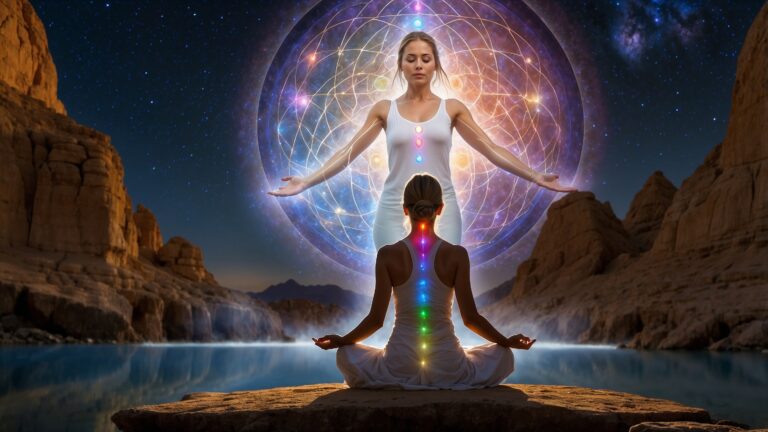

Have you ever wondered about the science of why one song can make you cry? This discussion explores a fascinating question is music a key that unlocks past life or ancestral memories stored in our DNA? Let’s delve into how a simple melody can evoke such a powerful emotional response, connecting us to memories we didn’t even know we had.
Prefer to watch? I’ve put my video below or if you’re a reader simply continue reading the post.
Music as a Carrier Wave for Information
Why is it that one particular song can bring you to tears? It’s because music is far more than just sound waves; it acts as a carrier wave for information. Think of it like a signal that transmits data. This signal doesn’t just entertain us, it also carries emotional and energetic information that our bodies can interpret on a profound level.
This information isn’t always something we process with our conscious minds. In fact, a simple chord progression can pull you back into an emotional memory that you might have long forgotten. The music effectively bypasses the logical mind and speaks directly to a deeper part of your being, which is where these powerful memories are stored.
Exploring The Science of Why One Song Can Make You Cry
The connection between music and deep emotion is rooted in frequency. A specific frequency within a chord can act as a key, and this key has the unique ability to unlock a door into your past. This is not just a poetic metaphor. The vibrational pattern of the music resonates with a corresponding vibrational pattern of a memory that is stored within you.
That one specific frequency of that chord is a key that unlocks a door into your past.
Suddenly, you might find yourself weeping, overwhelmed with an emotion that feels both ancient and intensely personal. This experience is a direct activation of a memory, triggered by the precise sonic key that the music provides. Consequently, it’s a powerful reminder that our bodies hold stories and experiences far older than our current lives.
Unlocking Ancestral and Past Life Memories in Your DNA
So, where are these powerful memories stored? An emerging perspective suggests they reside within our very DNA. This concept, explored in both spiritual and forward-thinking scientific circles, posits that our DNA is not just a biological blueprint but also a vast library of ancestral and even past life experiences. It is a living record of everything that has come before us.
Therefore, when you hear that specific song, the frequency of its chords can act like a password. It unlocks an encrypted file within your DNA, releasing the stored emotion and memory associated with it. This explains why a piece of music can feel so familiar and impactful, even if you’ve never consciously heard it before in this lifetime. It’s speaking a language your soul already understands. If this concept of sonic keys resonates, you may find my own music explores these themes, which you can stream on all platforms.
Understanding how these energetic memories are stored can be a transformative journey. It opens up pathways to deeper self-awareness, spiritual expansion, and personal growth. For those interested in exploring their own energetic blueprint and unlocking their potential, resources on topics like the chakra system can be very insightful. You might consider an event such as the Ignite Your 13 Chakra Blueprint to learn more. Be sure to check the schedule on the registration page for the next available class.