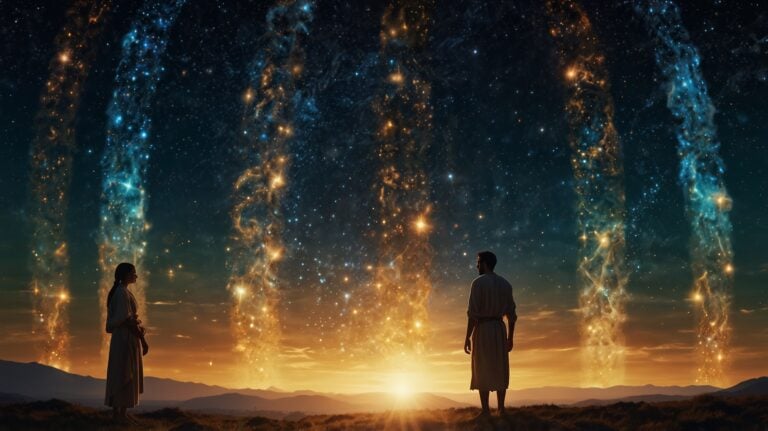

Have you ever wondered about the cosmic link between Sirius, Egypt, and Adam’s Calendar? Most people learn about these as separate subjects, but this perspective might change how you see history. What if the connection between Sirius, ancient Egypt, and Adam’s calendar points to a forgotten global understanding of cosmic cycles and humanity’s place within the universe?
Prefer to watch? I’ve put my video below or if you prefer to read simply scroll below.
Sirius and its Significance in Ancient Egypt
Across many ancient traditions, the star Sirius was seen as the maker of time, consciousness, and new beginnings. In ancient Egypt, its annual rising was a monumental event that signaled the flooding of the Nile River. This flooding brought life and abundance to the land, marking the start of a new cycle and a new year.
The Egyptians built their entire calendar system around the heliacal rising of Sirius. Its appearance represented divine order emerging from what might have otherwise seemed like chaos. This celestial event was so important because it provided a predictable rhythm to their agricultural and spiritual lives, reinforcing a deep connection between the cosmos and their civilization’s survival and prosperity.
Across many ancient traditions, Sirius wasn’t just another star, it was seen as the maker of time, consciousness, and new beginnings.
Adam’s Calendar and Ancient Astronomical Alignments
Adam’s Calendar, located in Mpumalanga, South Africa, is often described as one of the oldest manmade stone circles on Earth. Many researchers suggest its stone structures were intentionally aligned with specific astronomical events. This site raises fascinating questions about the knowledge our distant ancestors possessed about the stars and their movements.
While archaeologists continue to debate its exact age and purpose, Adam’s Calendar challenges the conventional narrative of history. How did ancient civilizations across different continents develop such a profound connection to celestial patterns? Was it merely observation, or were they tapping into a universal understanding of cosmic patterns that modern society has largely forgotten?
Merging Astronomy with Spirituality
Ancient cultures did not separate astronomy from spirituality as we often do today. For them, observing the stars was not just for navigation or timekeeping. It was a sacred practice for understanding humanity’s place within creation. The heavens were seen as a mirror of the Earth, and the Earth a reflection of the heavens, embodying the principle “As above, so below.”
Ancient cultures didn’t separate astronomy from spirituality. Looking at the stars was about understanding our place within creation.
Whether you view Sirius as a physical star, a symbol of higher consciousness, or a key element of human history, its story reminds us of something profound. Our ancestors spent thousands of years observing the rhythms of nature instead of trying to control them. They understood that all of creation follows cycles, from the movements of the stars and the Earth to the cycles within ourselves. Perhaps this is why these ancient sites continue to fascinate us. They don’t hold all the answers, but they invite us to start asking better questions.
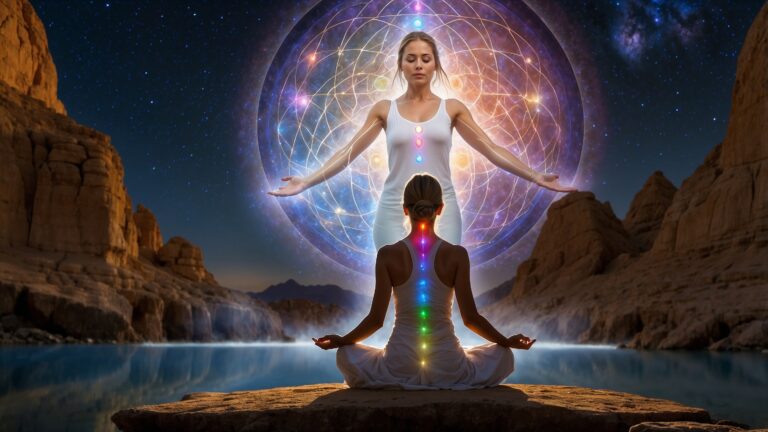
If you wish to explore the deeper connections between sacred sites, consciousness, and your own energetic system, you can join one of our live events. We often discuss the 13 Chakra blueprint to help you tap into these ancient understandings. You can check the schedule for our next training on the registration page at the link.
Frequently Asked Questions
Why was Sirius so important to ancient Egyptians?
Sirius was crucial to the ancient Egyptians because its annual rising coincided with the flooding of the Nile River. This event was the foundation of their agricultural calendar, heralding a new cycle of life, abundance, and fertility. The star’s appearance brought a sense of order and predictability to their world.
What is the significance of Adam’s Calendar?
Adam’s Calendar in South Africa is a stone circle believed by many researchers to be one of the oldest astronomical observatories on Earth. Its potential alignment with celestial events suggests that ancient people had an advanced understanding of the cosmos. It challenges us to reconsider how our ancestors interacted with the stars.
How did ancient cultures view the stars?
Ancient cultures viewed the stars as an integral part of their spiritual and daily lives, not just as distant objects. They saw the cosmos as a reflection of life on Earth, following the principle “As above, so below.” Observing celestial cycles was a way to understand their place in creation and the natural rhythms of the universe.